
The question of whether buah kurma is better fresh or dried assumes there are only two answers. There's actually a third, and it's the one this site's own namesake variety belongs to.
Three stages, not two
Dates ripen through khalal (hard, full-colour, still crunchy), rutab (soft, part-brown, high moisture), then tamr (fully dried, dark, wrinkled). Most of what gets sold in Malaysia falls cleanly into two commercial buckets built from those stages: fresh rutab, sold briefly during harvest and refrigerated, or fully-dried tamr, sold year-round at room temperature. Deglet Noor, Ajwa and Safawi are typically sold as hard tamr.
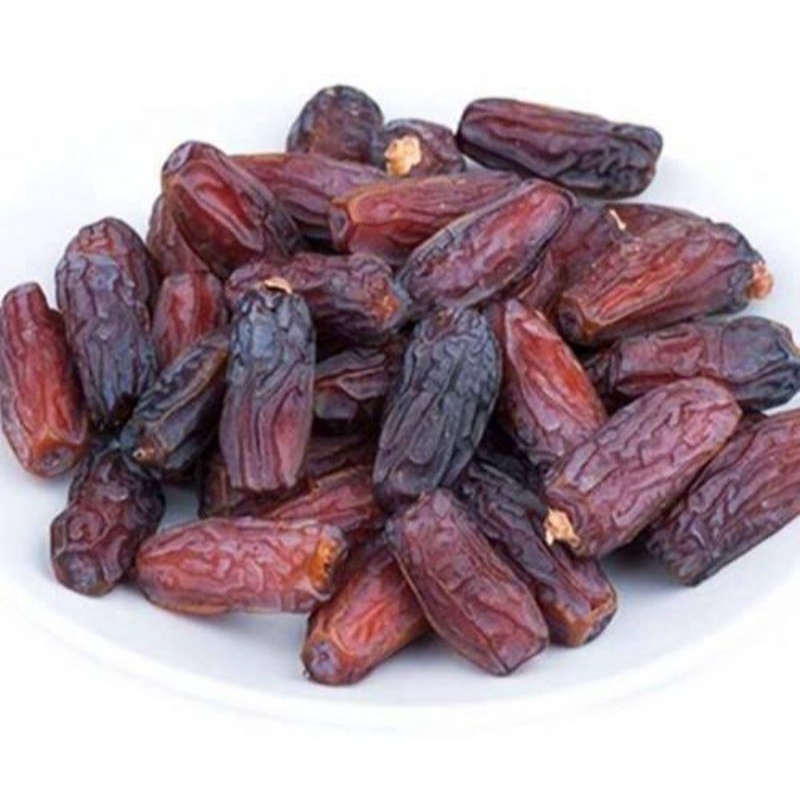
Mazafati doesn't sit at either end. It's picked at a soft, dark rutab-to-tamr transition point and deliberately not dried all the way down — the moisture is left in on purpose, which is exactly what gives it that near-black colour and soft, almost bruised-looking skin that first-time buyers sometimes mistake for spoilage. It isn't spoiled. It's meant to look and feel that way.
Why Mazafati is sold and stored like a fresh date
Because it keeps more of its water than a Deglet Noor or an Ajwa, Mazafati behaves closer to a fresh date in every practical sense: it needs the fridge, not the pantry, and it has a shorter shelf window — weeks in the fridge rather than months at room temperature, though freezing extends that considerably. Buyers who store it like a normal dried date, in a cupboard, will find it ferments or grows a white sugar bloom on the surface faster than a fully-dried variety would.
The trade-off is texture. That retained moisture is what makes Mazafati taste almost wet and slightly tart compared to the concentrated caramel sweetness of a bone-dry tamr date. It's closer to eating a very ripe fresh date than a shelf-stable dried one, even though technically it left the tree at a later stage than most fresh dates ever reach.
What this means when you're buying
If a listing simply says "fresh" or "dried" without naming the variety, that binary doesn't tell you much — ask which stage the specific variety was picked and cured at. For semi-moist varieties like Mazafati, check the packaging or ask the seller how it's been stored in transit; anything sitting unrefrigerated on a shelf for weeks has likely dried out further than intended, losing the texture that's the whole point of buying it in the first place. For fully-dried varieties, storage is far more forgiving, and grading and pricing tends to matter more than freshness handling.
Worth comparing Mazafati against some of the other less common varieties before assuming "fresh vs dried" is the only axis that matters — several of them sit at similarly in-between moisture points, just under less recognisable names. And if price is the deciding factor rather than texture, the grading breakdown explains why a semi-moist variety and a fully dried one at the same grade can still land at very different price points.