
Gout is a type of arthritis that causes sudden, severe joint pain, and it is caused by having too much uric acid in the blood (NHS). Water belongs in gout food advice too: the NHS lists getting dehydrated among the things that can trigger an attack. The 2020 American College of Rheumatology guideline adds that diet changes likely make only small changes to uric acid levels, but that dietary factors may act as triggers for attacks (FitzGerald et al., 2020). This guide covers two everyday habits: what you drink and how you cook.
This article is general information, not medical advice. If you have gout, follow the food list and treatment your own doctor gives you.
Keep a glass of water with every meal
To help prevent gout coming back, the NHS says to drink plenty of fluids to avoid getting dehydrated. During an attack it says to drink lots of water, unless a GP tells you not to. Its hydration page gives the Eatwell Guide figure of 6 to 8 cups or glasses of fluid a day, and says most people should aim to drink enough that their pee is a clear pale yellow (NHS water, drinks and hydration). You may need more in a hot environment or when you are physically active for long periods.
A glass beside every plate is an easy way to count those glasses. The same page lists water, lower-fat milk and lower-sugar drinks, including tea and coffee, as counting towards the daily total.
What goes in the glass matters too
In a 12-year study of 46,393 men, two or more sugar-sweetened soft drinks a day carried a relative risk of gout of 1.85 compared with less than one a month (Choi and Curhan, 2008). Diet soft drinks were not linked with gout. A 22-year study of 78,906 women found 778 new cases of gout, and two or more servings a day of orange juice carried a relative risk of 2.42 against less than one serving a month (Choi et al., 2010). The authors added that the contribution of these drinks to gout across the population is likely modest, because gout is not common in women. Both studies counted new cases of gout, not repeat attacks.
The NHS gout page says not to have lots of sugary drinks and snacks. It also suggests some alcohol-free days each week and no more than 14 units of alcohol a week, and lists drinking too much alcohol or eating a very large meal among attack triggers. The NHS hydration page limits fruit juice and smoothies to one small glass (150ml) a day, drunk with a meal.
Watch the fat you add when cooking
The NHS says the fats you add when cooking or serving are what increase the calorie content, giving oil on chips, butter on bread and creamy sauces on pasta as examples (NHS eight tips). For a healthier choice it suggests a small amount of vegetable or olive oil instead of butter, lard or ghee, and lean cuts of meat with the visible fat cut off. Grilling or steaming more often than frying is one way to put that into practice.
Weight is where this ties back to gout. The NHS says to try to lose weight if you are overweight, but to avoid crash diets. The ACR guideline conditionally recommends weight loss for people with gout who are overweight or obese, and rates the certainty of that evidence as very low.
What goes in the pan
In a case-crossover study of 633 people with gout, a 2-day period in the highest fifth of purine intake carried 4.76 times the odds of a gout attack compared with a 2-day period in the lowest fifth (Zhang et al., 2012). Purine from animal sources carried the higher risk, with odds of 2.41 in the top fifth against 1.39 for plant sources.
The food items the study asked about included all meats, organ meats, meat extracts and gravies, seafood, beans, peas, lentils, oatmeal, spinach, asparagus, mushroom, yeast, beer and other alcoholic drinks. Even so, the authors found the short-term effect of plant purine was substantially smaller than that of animal purine, and wrote that plant foods, especially nuts and legumes, should be the preferred protein sources for people with gout.
Fruit as the last course, not a separate snack
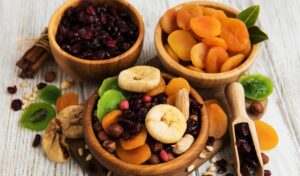
Dates are a fructose-rich fruit. USDA FoodData Central lists 32.0 g of fructose per 100 g of Medjool dates and 19.6 g per 100 g of Deglet Noor dates. In the study of men above, fructose-rich fruits (apples and oranges) and fruit juice were also linked with a higher risk of gout. None of the studies here tested dates, so they give no evidence either way on dates and gout.
The NHS counts a 30g portion of dried fruit, dates included, as one of your 5 A Day, and says it should be eaten at mealtimes, not as a snack between meals, to reduce the impact on teeth (NHS 5 A Day). Its sugar page says it is better for your teeth to eat dried fruit as part of a meal, or as part of a healthy dessert, than as a between-meal snack. So if dates are on your table, a weighed 30g portion at the end of a meal fits that advice.
Where this advice stops
This is a set of drinking and cooking habits, not a plan for managing gout. The NHS says your doctor may give you a list of foods to include or limit, and that uric acid-lowering medicine should be taken regularly, even when you no longer have symptoms. Vitamin C is one point where sources differ. The NHS says to ask a GP about vitamin C supplements, while the ACR guideline conditionally recommends against adding them, after two small trials of 29 and 40 patients showed clinically insignificant changes in uric acid.
Keep water with every meal, go easy on sugary drinks, add less fat when you cook, lean on plant protein, and let a weighed portion of fruit close the meal.
For quality Mazafati dates to keep on hand, see our range at Mazafati or read more About Us.
You can also reach us on WhatsApp through our Contact Us page.
References
- NHS. Gout. https://www.nhs.uk/conditions/gout/
- NHS. Water, drinks and hydration. https://www.nhs.uk/live-well/eat-well/food-guidelines-and-food-labels/water-drinks-nutrition/
- NHS. 8 tips for healthy eating. https://www.nhs.uk/live-well/eat-well/how-to-eat-a-balanced-diet/eight-tips-for-healthy-eating/
- NHS. 5 A Day: what counts? https://www.nhs.uk/live-well/eat-well/5-a-day/5-a-day-what-counts/
- NHS. Sugar: the facts. https://www.nhs.uk/live-well/eat-well/food-types/how-does-sugar-in-our-diet-affect-our-health/
- FitzGerald JD, et al. 2020 American College of Rheumatology Guideline for the Management of Gout. Arthritis Care Res (Hoboken). 2020;72(6):744-760. PMID 32391934
- Zhang Y, et al. Purine-rich foods intake and recurrent gout attacks. Ann Rheum Dis. 2012;71(9):1448-53. PMID 22648933
- Choi HK, Curhan G. Soft drinks, fructose consumption, and the risk of gout in men: prospective cohort study. BMJ. 2008;336(7639):309-12. PMID 18244959
- Choi HK, Willett W, Curhan G. Fructose-rich beverages and risk of gout in women. JAMA. 2010;304(20):2270-8. PMID 21068145
- USDA FoodData Central (SR Legacy). Dates, medjool, FDC 168191. https://fdc.nal.usda.gov/food-details/168191/nutrients
- USDA FoodData Central (SR Legacy). Dates, deglet noor, FDC 171726. https://fdc.nal.usda.gov/food-details/171726/nutrients